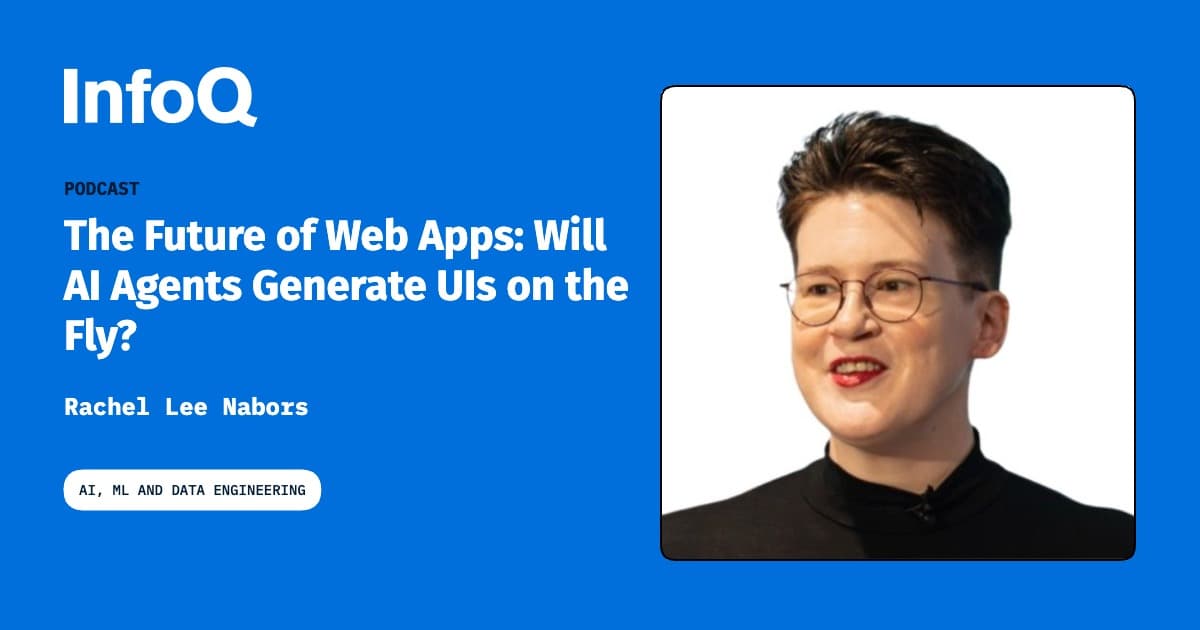
Podcast: The Future of Web Apps: Will AI Agents Generate UIs on the Fly?
Original Article Summary
Rachel Lee Nabors, former React core team member, dives into the architecture and philosophy behind local-first applications, exploring how small language models (SLMs) running directly on-device can deliver privacy-focused, low-latency, and cost-effective al…
Read full article at InfoQ.com✨Our Analysis
InfoQ's podcast “The Future of Web Apps: Will AI Agents Generate UIs on the Fly?” highlights Rachel Lee Nabors’ claim that small language models (SLMs) running directly on‑device can dynamically generate user interfaces, offering privacy‑first, low‑latency experiences without server‑side calls. For website owners, this signals an upcoming wave of on‑device AI agents that will crawl sites solely to harvest UI components—buttons, forms, navigation patterns—and then re‑assemble them locally for users. Because the processing happens client‑side, traditional server‑side bot detection (CAPTCHAs, rate limiting) will miss these agents, potentially inflating traffic metrics and exposing proprietary UI designs to competitors. Moreover, the privacy‑centric nature of SLMs means they will respect robots.txt but may ignore llms.txt, which was designed to signal LLM‑specific crawling preferences. **Actionable tips:** 1. Add an explicit `User‑Agent: *` entry in your llms.txt that disallows `/ui‑templates/` or any endpoint serving reusable UI fragments, ensuring on‑device agents know not to scrape them. 2. Deploy a lightweight client‑side script that injects a unique token into each rendered component; server logs can then differentiate human visits from AI‑generated UI requests. 3. Monitor real‑time traffic for sudden spikes in requests to static asset directories (CSS, SVG, component JSON) and set up alerts to flag potential SLM‑driven harvesting.
Track AI Bots on Your Website
See which AI crawlers like ChatGPT, Claude, and Gemini are visiting your site. Get real-time analytics and actionable insights.
Start Tracking Free →

