TorBot
Original Article Summary
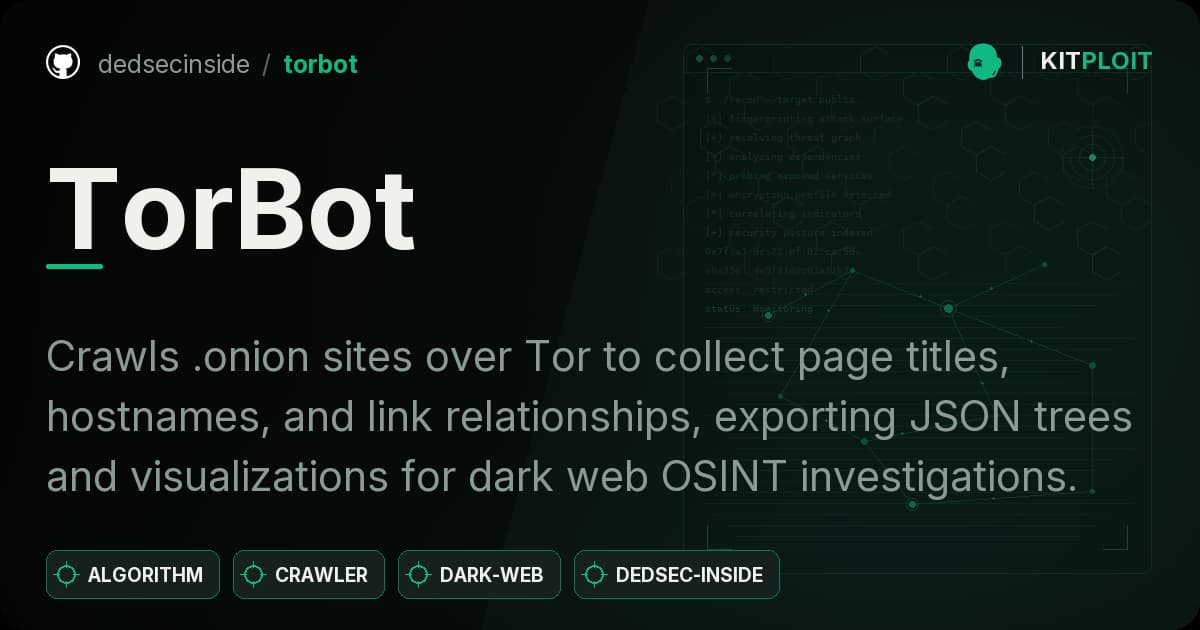
Crawls .onion sites over Tor to collect page titles, hostnames, and link relationships, exporting JSON trees and visualizations for dark web OSINT investigations.
Read full article at Kitploit.com✨Our Analysis
TorBot's release introduces a specialized crawler that scans .onion sites over Tor, harvesting page titles, hostnames, and link relationships, then exporting the data as JSON trees and visualizations for dark‑web OSINT investigations. For website owners, this means a new vector for automated discovery of hidden‑service content that could reference or embed links to their clear‑web domains. If a site’s brand, affiliate URLs, or API endpoints appear on the dark web, TorBot can surface those connections, exposing potential misuse, credential leaks, or illicit affiliate traffic. Moreover, the crawler’s ability to map link relationships may reveal how malicious actors are redirecting users from .onion pages to your site, affecting referral analytics and possibly inflating bot traffic in your logs. **Actionable tips:** 1. **Update your llms.txt** to explicitly disallow Tor‑based crawlers by adding a rule such as `User‑Agent: TorBot` `Disallow: /`. This signals legitimate bots to stay away and gives you a defensible stance if you need to block traffic. 2. **Implement IP‑level filtering** for known Tor exit nodes (lists are publicly available) and monitor for spikes in referral traffic from .onion‑linked sources. 3. **Integrate JSON log parsing** into your analytics pipeline to flag inbound requests that match titles or hostnames harvested by TorBot, enabling rapid response to brand abuse or credential exposure.
Related Topics
Track AI Bots on Your Website
See which AI crawlers like ChatGPT, Claude, and Gemini are visiting your site. Get real-time analytics and actionable insights.
Start Tracking Free →